

A Chinese restaurant in South Korea was vandalized for being named "Xi Jinping". (Video screenshot)
[People News] Xi Jinping, the General Secretary of the Communist Party of China, had just wrapped up his visit to the United States and returned to Beijing when South Korean media highlighted a significant incident: At around 2 a.m. on September 24, a Chinese restaurant named after "Xi Jinping" in Bundang, Gyeonggi Province, was broken into and vandalized with spray paint. Police confirmed that all four suspects involved are Chinese citizens and have reportedly fled back to China after the incident, believed to have escaped to Yantai and Shanghai.
South Korean police revealed that the name "Xi Jinping" on the restaurant's sign was completely obscured by a layer of black spray paint, rendering it nearly unrecognizable. Additionally, the walls and furniture inside the restaurant were sprayed with a significant amount of red and black paint, and even the kitchen ingredients were doused with an unidentified substance suspected to be pesticide. Police collected empty pesticide containers and several cans of insecticide from the scene.
Surveillance footage shows that the four individuals, wearing masks and hats to conceal their identities, vandalized the restaurant for approximately an hour. They then took a taxi back to their accommodation in Seoul before heading directly to Incheon Airport to leave the country.
In an interview with local media, the restaurant owner revealed that he has been receiving a series of protest calls over the past few months due to the name of his restaurant, and some individuals have even come to confront him. Two months ago, a similar incident occurred when someone sprayed black paint on the sign and fled, but the police stated at the time that it was difficult to identify the suspect. A local resident confessed, 'When this store first opened, everyone was curious if it was really acceptable to use Xi Jinping's name for the restaurant. When I saw the news, I thought: 'This was bound to happen.' '
The suspects not only vandalized the property by spraying paint but also sprayed poison on the food and slashed the seats with knives. These extreme actions, which resemble a 'terrorist attack,' have heightened the Korean public's awareness and aversion to the activities of extreme nationalists from China in Korea.
Following the media coverage, the incident ignited intense discussions among Korean media, the overseas Chinese community, and international audiences. Given that the name 'Xi Jinping' consists of highly sensitive characters within China, nearly all participants in the discussion were overseas Chinese and mainland netizens who have bypassed the Great Firewall.
On social media, opinions were diverse: 'Did the Korean police intentionally release the four Chinese suspects?' 'With such meticulous destruction, isn't this just a way to vent long-standing grievances?' 'The owner should change it to a name that everyone despises, one that brings destruction without any construction, a name associated with a virus that killed millions. This is karma.' 'It is evident that this store name is very unlucky.' Due to the ongoing vandalism, the name 'Xi Jinping' has caused endless trouble, and the restaurant owner ultimately announced plans to change the restaurant's name.
In terms of the motive behind the incident, many speculate that the perpetrators could be 'little pinks' or extreme left-wing nationalists, who likely perceive overseas businesses using 'Xi Jinping' for commercial purposes as a 'serious insult to China.' One netizen sarcastically commented, 'This truly highlights the cunning and cowardice of the 'wolf warrior' mentality.'
Additionally, many netizens immediately recalled the 'ink-splashing incident' involving Dong Yaoqiong in 2018. They humorously pointed out that back then, anti-communist citizens splashed ink on a statue of Xi and were sent to a mental hospital; now, the 'little pinks' have gone to South Korea to spray the name 'Xi Jinping' entirely black in an effort to uphold the leader's authority. 'Objectively speaking, this is essentially a high-level black 'officially sanctioned ink-splashing,' making the leader's name dirtier than anyone else's.'
However, some analysts believe that these four Chinese individuals are likely victims of the Communist Party's authoritarian regime, and their actions are merely an expression of their extreme anger towards the CCP.
For many ordinary people who have experienced oppression under the CCP, the term 'Communist Party' is relatively abstract; in contrast, 'Xi Jinping' represents a concrete figure of the CCP. He and his family have accumulated vast wealth through this, making 'Xi Jinping' a natural target for the oppressed Chinese populace to express their hatred towards the Communist Party.
When ordinary citizens lose loved ones during the COVID-19 pandemic or suffer painful side effects from domestically produced vaccines; when they lose most of their assets due to economic recession, waves of unemployment, and unfinished real estate projects, leaving them in desperate situations; and when food safety crises, intense surveillance, and ineffective social relief make even basic sustenance a challenge, the public inevitably blames the highest decision-makers. The name 'Xi Jinping' has become a symbol of the various flaws and oppressions within the entire system.
In mainland China, those who engage in spray painting can face severe persecution, like Dong Yaoqiong, but taking action overseas is relatively safer. Therefore, they choose to act abroad. In the minds of these individuals venting their frustrations, a restaurant that dares to use the party leader's name is automatically labeled as a 'worshiper of the CCP,' a 'red-cap merchant beautifying the dictatorship,' or an 'accomplice profiting from the dictator's fame,' making its ingredients targets for destruction.
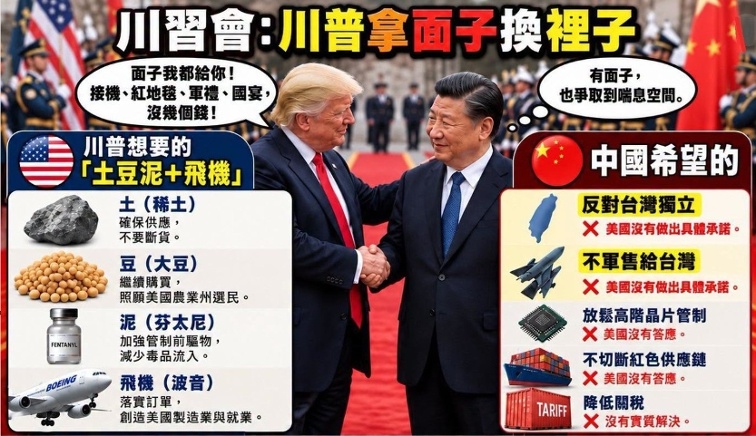
It is unclear whether Xi Jinping, far away in Beijing, feels a sense of shame upon hearing about this incident. As a world-class political figure, the name of American President Trump, who just shook hands with him in Washington, is displayed on many buildings in prime locations around the world, symbolizing wealth and commercial success; in contrast, the name 'Xi Jinping' appears overseas, only to be met with black paint sprayed by Chinese citizens! This starkly illustrates the true standing of the CCP's representatives and the President of the free world in the eyes of the public.
Regardless of whether it is the 'ink splatter' driven by anti-communist sentiments or the 'spray paint' that erupts from extreme patriotism, the visual outcome is the chaotic and absurd depiction of the name '习近平' (Xi Jinping) obscured by black paint. This has turned into prime satirical content for overseas public opinion and self-media.
(First published by People News) △






News magazine bootstrap themes!
I like this themes, fast loading and look profesional
Thank you Carlos!
You're welcome!
Please support me with give positive rating!
Yes Sure!